ar|in blog post
ar|in blog post
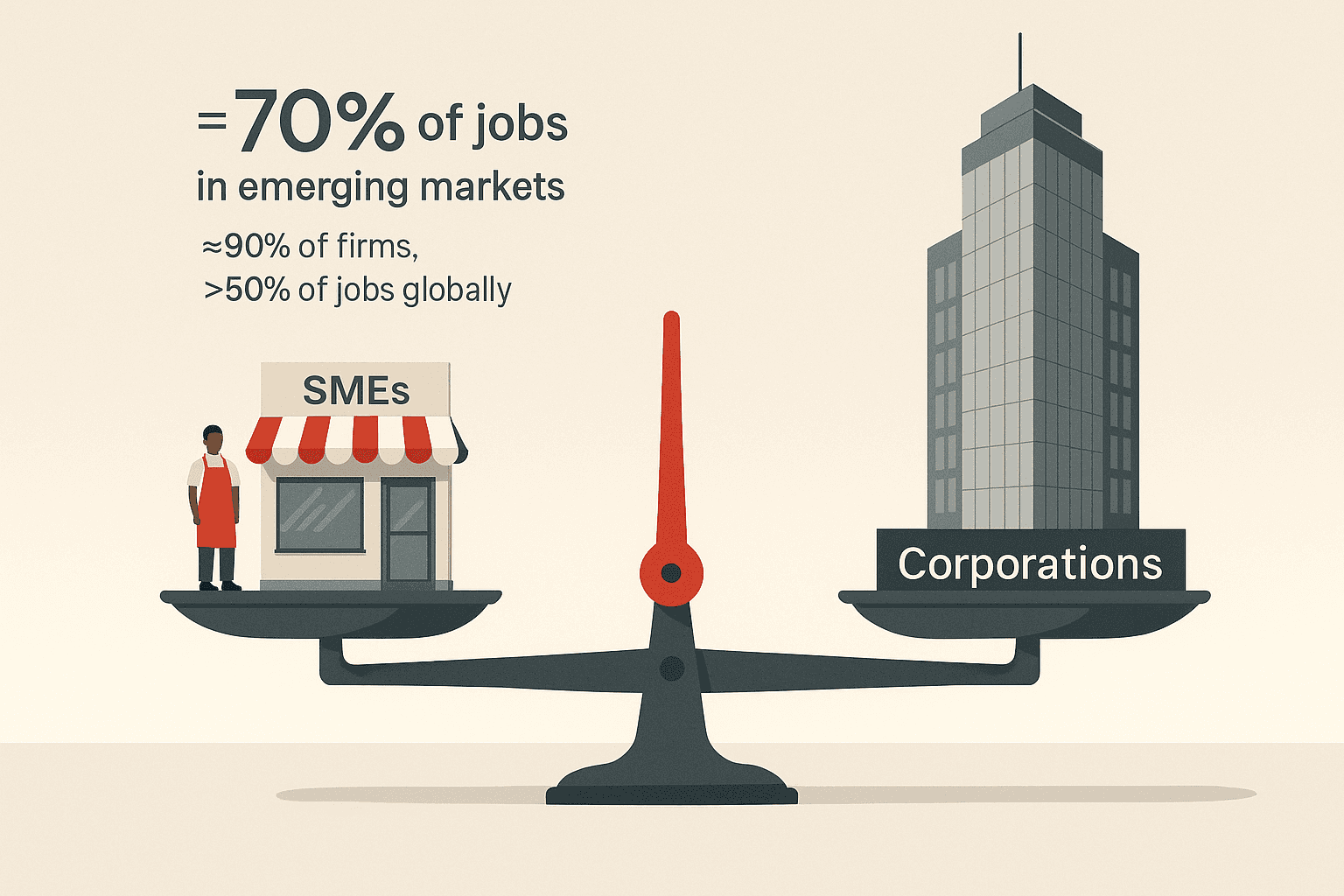
small businesses aren’t just participants in the global economy — they are the backbone. according to the world bank, smes represent about 90% of businesses worldwide and more than 50% of employment. in emerging markets, they create up to 7 out of 10 jobs.
their importance is universal. from london to lagos, from delhi to detroit, smes fuel growth, innovation, and resilience. yet when discussions turn to “digital transformation,” the spotlight often shifts to multinational corporations. that’s a mistake. it’s smes that determine whether economies remain competitive in a digital-first world.
productivity under pressure
productivity growth has slowed across advanced and emerging economies alike. the oecd reports persistent gaps between large firms and smes, with smaller businesses often lagging behind in digital adoption (oecd outlook). the reasons aren’t lack of ambition — they’re structural.
owners juggle multiple roles. budgets are tight. access to skilled digital talent is limited. every investment carries risk. so while enterprises fund transformation programs, many smes remain stuck in manual, paper-heavy processes.
this matters because productivity is the engine of economic growth. when smes stay analog, entire economies underperform.
the digital momentum
change is happening. a growing share of smes are embracing automation and ai. intuit quickbooks found that small businesses adopting automation save up to 30% of weekly time previously lost to admin.
globally, mckinsey reports that two-thirds of businesses using ai see measurable revenue gains. the international monetary fund estimates that widespread adoption of ai among smes could add trillions to global gdp by the mid-2030s (imf blog).
the pattern is clear: ai adoption correlates with higher productivity, faster revenue growth, and more resilient business models.
the adoption gap
yet adoption remains uneven. in every region, a significant share of smes haven’t experimented with ai at all. barriers include:
cost — many tools are priced for enterprises, not small budgets.
skills — teams lack training, and owners can’t spare time to learn.
trust — fear that automation could damage customer relationships or introduce compliance risks.
the oecd confirms that smaller firms consistently face higher hurdles to digitalization compared to large corporations. this creates a digital divide that risks widening economic inequality between firms and countries.
intent, however, is strong. surveys show that more than 40% of smes name productivity as their top priority, but fewer than a quarter have concrete plans to upgrade infrastructure (techradar).
why smes actually have the edge
ironically, once smes adopt technology, they often outperform corporates.
oxford economics found that small firms implementing ai experienced 20–60% productivity gains, compared to slower, incremental improvements in large enterprises.
why? because agility beats scale. smes can make fast decisions, pilot quickly, and adjust without bureaucratic overhead. founder-led structures and shorter feedback loops make adoption smoother. what looks like a disadvantage in size becomes an advantage in speed.
practical use cases
across sectors, the gains are tangible:
hospitality: ai-powered chatbots answering booking questions 24/7 increased direct reservations by 15% (mckinsey).
retail: predictive inventory systems cut stockouts and reduced holding costs by 25% (pwc).
professional services: automated scheduling and billing freed up 8–12 hours per week, increasing client-facing time (forbes).
manufacturing: predictive maintenance reduced downtime by up to 30% (gartner).
these examples span industries and regions, but share a theme: automation handles the repetitive, humans focus on the meaningful.
off-the-shelf vs custom
for many smes, the first step is off-the-shelf tools — microsoft copilot, chatgpt, or ready-made saas bots. they’re easy to start with, but they’re generic. they don’t know your product catalog, your crm history, or your tone of voice.
research from gartner shows that companies layering customized ai on top of generic tools see up to 40% higher roi. customization means training on your own data, embedding into your workflows, and speaking in your voice.
the smart strategy is hybrid: use off-the-shelf for pilots, then scale with custom systems tailored to your processes.
small businesses aren’t just participants in the global economy — they are the backbone. according to the world bank, smes represent about 90% of businesses worldwide and more than 50% of employment. in emerging markets, they create up to 7 out of 10 jobs.
their importance is universal. from london to lagos, from delhi to detroit, smes fuel growth, innovation, and resilience. yet when discussions turn to “digital transformation,” the spotlight often shifts to multinational corporations. that’s a mistake. it’s smes that determine whether economies remain competitive in a digital-first world.
productivity under pressure
productivity growth has slowed across advanced and emerging economies alike. the oecd reports persistent gaps between large firms and smes, with smaller businesses often lagging behind in digital adoption (oecd outlook). the reasons aren’t lack of ambition — they’re structural.
owners juggle multiple roles. budgets are tight. access to skilled digital talent is limited. every investment carries risk. so while enterprises fund transformation programs, many smes remain stuck in manual, paper-heavy processes.
this matters because productivity is the engine of economic growth. when smes stay analog, entire economies underperform.
the digital momentum
change is happening. a growing share of smes are embracing automation and ai. intuit quickbooks found that small businesses adopting automation save up to 30% of weekly time previously lost to admin.
globally, mckinsey reports that two-thirds of businesses using ai see measurable revenue gains. the international monetary fund estimates that widespread adoption of ai among smes could add trillions to global gdp by the mid-2030s (imf blog).
the pattern is clear: ai adoption correlates with higher productivity, faster revenue growth, and more resilient business models.
the adoption gap
yet adoption remains uneven. in every region, a significant share of smes haven’t experimented with ai at all. barriers include:
cost — many tools are priced for enterprises, not small budgets.
skills — teams lack training, and owners can’t spare time to learn.
trust — fear that automation could damage customer relationships or introduce compliance risks.
the oecd confirms that smaller firms consistently face higher hurdles to digitalization compared to large corporations. this creates a digital divide that risks widening economic inequality between firms and countries.
intent, however, is strong. surveys show that more than 40% of smes name productivity as their top priority, but fewer than a quarter have concrete plans to upgrade infrastructure (techradar).
why smes actually have the edge
ironically, once smes adopt technology, they often outperform corporates.
oxford economics found that small firms implementing ai experienced 20–60% productivity gains, compared to slower, incremental improvements in large enterprises.
why? because agility beats scale. smes can make fast decisions, pilot quickly, and adjust without bureaucratic overhead. founder-led structures and shorter feedback loops make adoption smoother. what looks like a disadvantage in size becomes an advantage in speed.
practical use cases
across sectors, the gains are tangible:
hospitality: ai-powered chatbots answering booking questions 24/7 increased direct reservations by 15% (mckinsey).
retail: predictive inventory systems cut stockouts and reduced holding costs by 25% (pwc).
professional services: automated scheduling and billing freed up 8–12 hours per week, increasing client-facing time (forbes).
manufacturing: predictive maintenance reduced downtime by up to 30% (gartner).
these examples span industries and regions, but share a theme: automation handles the repetitive, humans focus on the meaningful.
off-the-shelf vs custom
for many smes, the first step is off-the-shelf tools — microsoft copilot, chatgpt, or ready-made saas bots. they’re easy to start with, but they’re generic. they don’t know your product catalog, your crm history, or your tone of voice.
research from gartner shows that companies layering customized ai on top of generic tools see up to 40% higher roi. customization means training on your own data, embedding into your workflows, and speaking in your voice.
the smart strategy is hybrid: use off-the-shelf for pilots, then scale with custom systems tailored to your processes.
small businesses power the digital economy
backbone status → productivity levers → adoption gap
smes are the backbone everywhere — ~90% of firms and >50% of jobs worldwide; up to 7 in 10 jobs in emerging markets (world bank).
the backbone in numbers
policy + tooling should start with smes, not end with them.
the adoption gap
pattern from techradar. conclusion: intent is high, readiness is low.
what drives productivity
agility is the edge: smaller teams adopt and iterate faster.
tooling: fast vs durable value
- quick setup (general copilots, chat tools, saas bots)
- generic; little business context
- hard to enforce voice + workflows
- good to learn; weak long-term roi
- trained on your products, policies, crm
- on-brand tone, guardrails, integrations
- handles edge cases; less rework
- higher roi; scales with your process
references: world bank, oecd, mckinsey, intuit, pwc, techradar.
how to start
map the friction — pick 2–3 workflows that eat time: customer inquiries, lead triage, invoicing.
organize your data — centralize faqs, tickets, policies, and product info. even spreadsheets help.
pilot narrowly — automate one process. define simple metrics: hours saved, errors reduced, conversions gained.
keep humans in the loop — route exceptions to staff, review outputs, tune tone.
train your team — show staff that ai removes busywork, not their jobs.
scale gradually — expand only when results hold steady.
these steps aren’t glamorous, but they compound into real productivity.
moving forward
small businesses are the growth engine of every economy. their digital adoption — or lack of it — will determine productivity at both the firm and national level.
the opportunity is enormous. ai adoption could unlock trillions globally, as forecast by the imf. the risk is equally clear: firms that delay will face higher costs, weaker competitiveness, and missed opportunities.
the path isn’t about more software licenses. it’s about confidence, integration, and tailoring. when smes adopt ai that fits their workflows, the impact is structural. costs scale predictably. service quality improves. growth becomes sustainable.
at ar¦in, we design ai agents built specifically for smes. our systems automate repetitive commercial and admin work while carrying your voice and integrating with your tools. unlike generic bots, they scale with you
ready to put generative ai to work?
test ari right here, and when you're ready, book a free session we’ll review your workflows, highlight quick wins, and build automations that deliver real roi.
how to start
map the friction — pick 2–3 workflows that eat time: customer inquiries, lead triage, invoicing.
organize your data — centralize faqs, tickets, policies, and product info. even spreadsheets help.
pilot narrowly — automate one process. define simple metrics: hours saved, errors reduced, conversions gained.
keep humans in the loop — route exceptions to staff, review outputs, tune tone.
train your team — show staff that ai removes busywork, not their jobs.
scale gradually — expand only when results hold steady.
these steps aren’t glamorous, but they compound into real productivity.
moving forward
small businesses are the growth engine of every economy. their digital adoption — or lack of it — will determine productivity at both the firm and national level.
the opportunity is enormous. ai adoption could unlock trillions globally, as forecast by the imf. the risk is equally clear: firms that delay will face higher costs, weaker competitiveness, and missed opportunities.
the path isn’t about more software licenses. it’s about confidence, integration, and tailoring. when smes adopt ai that fits their workflows, the impact is structural. costs scale predictably. service quality improves. growth becomes sustainable.
ready to put generative ai to work?
test ari right here, and when you're ready, book a free session we’ll review your workflows, highlight quick wins, and build automations that deliver real roi.
how to start
map the friction — pick 2–3 workflows that eat time: customer inquiries, lead triage, invoicing.
organize your data — centralize faqs, tickets, policies, and product info. even spreadsheets help.
pilot narrowly — automate one process. define simple metrics: hours saved, errors reduced, conversions gained.
keep humans in the loop — route exceptions to staff, review outputs, tune tone.
train your team — show staff that ai removes busywork, not their jobs.
scale gradually — expand only when results hold steady.
these steps aren’t glamorous, but they compound into real productivity.
moving forward
small businesses are the growth engine of every economy. their digital adoption — or lack of it — will determine productivity at both the firm and national level.
the opportunity is enormous. ai adoption could unlock trillions globally, as forecast by the imf. the risk is equally clear: firms that delay will face higher costs, weaker competitiveness, and missed opportunities.
the path isn’t about more software licenses. it’s about confidence, integration, and tailoring. when smes adopt ai that fits their workflows, the impact is structural. costs scale predictably. service quality improves. growth becomes sustainable.
at ar¦in, we design ai agents built specifically for smes. our systems automate repetitive commercial and admin work while carrying your voice and integrating with your tools. unlike generic bots, they scale with you
ready to put generative ai to work?
test ari right here, and when you're ready, book a free session we’ll review your workflows, highlight quick wins, and build automations that deliver real roi.
how it works — and why it’s different
one of the biggest misconceptions about ai is that it’s complicated or requires a big tech team. not with ar|in.
you don’t need to disrupt your business or hire an it department to get started.
if your customers reach you through a website, social media, or messaging — ar|in’s conversational ai agents can meet them there, in real time, on their terms.
you can actually try it right here on this page try ari - our conversational agent - see how quickly it responds, how naturally it communicates, and how well it understands questions about your business. it’s like having a reliable, always-on team member who never calls in sick.
but unlike traditional chatbots that offer static scripts and canned responses, ar|in’s conversational ai suite is designed for real commercial impact.
here’s what conversational ai can do for you
marketing: capture leads 24/7, welcome new visitors across your digital channels, and qualify prospects while you sleep.
sales: answer product or service questions, guide visitors toward the right package, and nurture interest until they’re ready to buy.
after-sales: automate follow-ups, collect feedback, and resolve common support requests — keeping customers happy and reducing churn.
analytics & insights: get visibility into what your customers are asking for most, and which parts of your funnel cause them to drop off — so you can improve.
human-in-the-loop: you’re always in control. you decide when to step in — for sensitive topics, escalations, or complex conversations that need the personal touch.
a solution built to scale with you
the best part? ar|in’s solution is fully managed and designed to grow alongside your business. you don’t have to worry about maintaining it, training it, or constantly updating it. we handle that for you.
so whether you’re a solo founder handling every customer inquiry yourself, or a growing team juggling multiple channels, our solution gives you enterprise-grade power without the enterprise budget — or headcount.
you stay focused on what matters. we handle the rest.
in summary
balancing growth and productivity is a never-ending challenge for small businesses. the value of conversational ai isn’t about replacing people — it’s about giving us space to do our best work.
it allows us to serve smarter, scale faster, and stay responsive — without burning out or stretching ourselves too thin. it turns our existing customer interactions into data-rich insights, gives our leads instant attention, and helps us deliver consistent service — even on our busiest days.
most importantly, it gives us time. and time is what small business owners need most.
ready to see it in action?
test ari right here, and when you're ready, book a free session to talk about your needs and how we can tailor our solution to your needs
blog
read more articles
read more articles on ways ai and automation empower small to medium-sized businesses
blog
read more articles
read more articles on ways ai and automation empower small to medium-sized businesses

implementation
7 min read
implementing ai in your small business without the headache
the right way for small businesses to adopt ai and automation
read more

productivity
6 min read
powering productivity: why small businesses drive the digital economy
how small businessesses narrow the productivity gap in the digital age
read more
growth
5 min read
ai and the new entrepreneurial wave: how small business reinvents growth
can technology allow small businesses to drive tomorrow's growth?
read more
automation opportunity self-assessment tool

find out where automation can have the biggest impact in your business.
in a few quick questions, see how ready your systems are — and where ai can save you the most time and cost.
enterprise-level service without the enterprise price tag:
higher revenue and more efficient operations for 91% of smbs (source: salesforce via us chamber of commerce).
up to 80% of routine customer inquiries automatically (source: invesp)
improved response quality and speed in service for 90% of smbs (source: colorwhistle)
ar|in - automate your growth
meet ari, ar|in's ai workforce in action
discover how an ai-enabled automation workforce can transform your business. click a question on the right or ask your own to try ari live and get instant answers!
secure by design: "complies with the highest data protection standards, for private & secure interactions.
multitasker: "handles multiple customers at the same time—like a full team."
your agent, your brand: "applies your processes, in your brand voice, for your customers' needs."
natural conversations: "has normal, engaging conversations with your customers."
where your customers are: "serves customers where they prefer—web, social media, or messaging apps."
emotional intelligence: "understands & responds to customer emotions for better engagement."
always learning: "learns individual preferences from every interaction for a better experience next time."
ar|in - automate your growth
meet ari, ar|in's ai workforce in action
discover how an ai-enabled automation workforce can transform your business. click a question on the right or ask your own to try ari live and get instant answers!
secure by design: "complies with the highest data protection standards, for private & secure interactions.
multitasker: "handles multiple customers at the same time—like a full team."
your agent, your brand: "applies your processes, in your brand voice, for your customers' needs."
natural conversations: "has normal, engaging conversations with your customers."
where your customers are: "serves customers where they prefer—web, social media, or messaging apps."
emotional intelligence: "understands & responds to customer emotions for better engagement."
always learning: "learns individual preferences from every interaction for a better experience next time."
ar|in - automate your growth
meet ari, ar|in's ai workforce in action
discover how an ai-enabled automation workforce can transform your business. click a question on the right or ask your own to try ari live and get instant answers!
secure by design: "complies with the highest data protection standards, for private & secure interactions.
multitasker: "handles multiple customers at the same time—like a full team."
your agent, your brand: "applies your processes, in your brand voice, for your customers' needs."
natural conversations: "has normal, engaging conversations with your customers."
where your customers are: "serves customers where they prefer—web, social media, or messaging apps."
emotional intelligence: "understands & responds to customer emotions for better engagement."
always learning: "learns individual preferences from every interaction for a better experience next time."
ar|in - automate your growth
meet ari, ar|in's ai workforce in action
discover how an ai-enabled automation workforce can transform your business. click a question on the right or ask your own to try ari live and get instant answers!
secure by design: "complies with the highest data protection standards, for private & secure interactions.
multitasker: "handles multiple customers at the same time—like a full team."
your agent, your brand: "applies your processes, in your brand voice, for your customers' needs."
natural conversations: "has normal, engaging conversations with your customers."
where your customers are: "serves customers where they prefer—web, social media, or messaging apps."
emotional intelligence: "understands & responds to customer emotions for better engagement."
always learning: "learns individual preferences from every interaction for a better experience next time."
*expect a few seconds for a reply as your request gets sent to the correct automation workflow
not ready to book yet? check out how we keep your data safe
ai agents industry insights & data
the data speaks for itself—ai is transforming customer service and business growth opportunities for companies of all sizes.
the small business opportunity
conversational ai empowers small businesses to offer enterprise-level service without the enterprise price tag:
enterprise-level service without the enterprise price tag:
can save up to 30% on customer service costs (source: forbes).
higher revenue and more efficient operations for 91% of smbs (source: salesforce via us chamber of commerce).
handle up to 80% of routine customer inquiries automatically (source: invesp)
up to 80% of routine customer inquiries automatically (source: invesp)
provide 24/7 customer support without additional staffing
improved response quality and speed in service for 90% of smbs (source: colorwhistle)
higher revenue and more efficient operations for 91% of smbs (source: salesforce via us chamber of commerce).
up to 80% of routine customer inquiries automatically (source: invesp)
improved response quality and speed in service for 90% of smbs (source: colorwhistle)
ar|in - automate your growth
ar|in - automate your growth
ar|in - automate your growth
ar|in - automate your growth
we want to be partners in your growth
i'm lamine kane, founder and builder of ar|in. with experience leading small businesses and multi-million-dollar corporate teams, i understand how challenging it is for small enterprises to compete with larger companies. that's why i created ar|in—to help bridge the gap with affordable ai solutions for customer engagement, sales, and the repetitive but important processes that keep businesses running.
we're here to help your small to medium-sized business fast and sustainably

learn more about ar|in
book your free consultation—let's get started!
ready to transform your business? let's explore how our ai agents can help you grow and scale.
pick a time that works for you, and we'll discuss your unique needs. our tailored ai solution will help you reach your goals—starting with a free consultation.
book your free consultation—let's get started!
ready to transform your business? let's explore how our ai agents can help you grow and scale.
pick a time that works for you, and we'll discuss your unique needs. our tailored ai solution will help you reach your goals—starting with a free consultation.
book your free consultation—let's get started!
ready to transform your business? let's explore how our ai agents can help you grow and scale.
pick a time that works for you, and we'll discuss your unique needs. our tailored ai solution will help you reach your goals—starting with a free consultation.
book your free consultation—let's get started!
ready to transform your business? let's explore how our ai agents can help you grow and scale.
pick a time that works for you, and we'll discuss your unique needs. our tailored ai solution will help you reach your goals—starting with a free consultation.
want to stay in the loop?
subscribe to our newsletter for regular insights on how to use ai to accelerate your business growth.
ar|in growth accelerator
ar|in growth accelerator
join our community for the latest updates and exclusive insights.
quick links
quick links
resources
resources