ar|in blog post
ar|in blog post

search for news about generative ai and jobs these days and you'll probably get headlines that feel like they belong in the necrology section of a newspaper, announcing which job just died (or, if it's a viral tweet, linkedin post or youtube video it's more lilely to say the job is "cooked", "finished", "done", "extinct", "toast", "over", "bust"), and which one is "next".
i am clearly not safe from the temptation of a catchy headline either of course (just read up).
these headlines make it sound like ai coming for our jobs is inevitable, and imminent.
this is not new: an exciting technology appears, and we conclude it will wipe out jobs almost overnight.
ai is just the latest chapter in that story.
the data
mckinsey's new report titled: "agents, robots, and us: skill partnership in the age of ai" states that today’s technologies (ai agents, robots and workflow redesign) could in theory automate 57 percent of current work hours in the u.s. (44% of that coming from ai agents).
it is important to note that it does not say 57% of jobs. and it specifies "in theory" because those numbers assume perfect technical conditions which almost never match how work happens in real life.
so the technical potential of an innovation and its real adoption in the workplace are two different things. electricity took more than three decades to become standard in factories even though it was clearly better than steam.
robotics, cloud, and machine learning followed a similar paths. organizations take time to redesign systems, train people, and adjust responsibilities.
what this means for jobs
ai and automation will likely reshape certain jobs, and some roles will likely decline, as new ones emerge but the net impact on labor is hard to predict.
the oecd estimates that about 14 percent of jobs across member countries are highly automatable, concentrated in routine administrative, clerical, and predictable production work.
but yale budget lab concludes that “measures of exposure, automation, and augmentation show no sign of being related to changes in employment or unemployment” and that “better data is needed to fully understand the impact of ai on the labor market”.
then goldman sachs, states that “ai adoption is expected to have only a modest and relatively temporary impact on employment levels”.
yet forbes recently published an article titled "ai is not killing entry level jobs" based on research that concludes looking at the the declining youth employment assumed to be caused by ai that the: "junior hiring crash started in 2022, before many ceos knew what prompt engineering was."
so there is really no consensus on how ai will or will not impact employment rates
that is probably because this will be driven by many factors beyond the technology’s capabilities such.
psychology (loss aversion, confirming or anchoring biases),
policy (labor regulation, education and retraining systems, social safety nets),
economics (wage dynamics, productivity distribution, capital investment),
and ethical and moral choices (fairness, responsibility, and how societies value human work).
etc.
any definitive statements on how ai will impact job numbers should be taken with a grain of salt.
the immediate opportunity is in task removal
what the data does show is that ai in its current and foreseeable state can affect what people do, rather than whether they are needed.
mckinsey’s analysis shows that while 57% of work hours contain activities that could be automated, 43% still require social and emotional capabilities that current systems cannot perform. these activities rely on sensing client uncertainty, navigating conflict, reading context, and building trust.
how generative ai works
so why can’t ai take over fully and exclusively these relational skills when modern models can identify tone and mood from our inputs? sentiment classifiers can flag frustration. chatbots can respond with language such as i understand why that feels difficult. this can give the impression of understanding.
but the underlying mechanics are different from what people generally implicitely assume when they say understanding.
this piece by mit highligths that large language models operate through next token prediction. they select the most statistically likely token based on patterns in their training data. a token isthe fundamental unit of data used to process and generate text.
ai models can't directly "read" text like humans, they break down language into smaller chunks called tokens, which are then converted into numerical values for mathematical processing.
llms do not interpret meaning, researchers explain, they work with tokens as numerical vectors, not grounded semantic concepts. they do not know what frustration is; they only recognize the patterns of language associated with it.
linguists describe this gap as a difference between sign and meaning. in simple terms, humans link words to lived experience, context, and shared understanding. llms do not attach meaning. they generate statistically coherent sequences based on correlations in large datasets.
this gap also explains "hallucinations" in generative ai.
this nature article explains that, contrary to belief, hallucinations (when chatgpt or your favorite conversational ai tells you something that is not true) aren't bugs or malfunctions, they are inherent to how llms are designed on matching patterns and predicting the next word from their training data.
so, llms are trained on vast text data, not facts. they generate plausible-sounding text by filling gaps with statistically likely words, essentially fabricating details that fit the context but aren't necessarily true
the most statistically coherent sequence does not necessarily lead to the right decision.
this limitation matters in practical settings. ai can surface signals. it can predict likely responses. but it cannot take responsibility, interpret intent, or sense nuance through experience. these tasks still require people.
letting an unconstrained llm run a business is a risky proposition.
but…
search for news about generative ai and jobs these days and you'll probably get headlines that feel like they belong in the necrology section of a newspaper, announcing which job just died (or, if it's a viral tweet, linkedin post or youtube video it's more lilely to say the job is "cooked", "finished", "done", "extinct", "toast", "over", "bust"), and which one is "next".
i am clearly not safe from the temptation of a catchy headline either of course (just read up).
these headlines make it sound like ai coming for our jobs is inevitable, and imminent.
this is not new: an exciting technology appears, and we conclude it will wipe out jobs almost overnight.
ai is just the latest chapter in that story.
the data
mckinsey's new report titled: "agents, robots, and us: skill partnership in the age of ai" states that today’s technologies (ai agents, robots and workflow redesign) could in theory automate 57 percent of current work hours in the u.s. (44 of that 57% coming from ai agents).
it is important to note that it does not say 57% of jobs. and it specifies "in theory" because those numbers assume perfect technical conditions which almost never match how work happens in real life.
so the technical potential of an innovation and its real adoption in the workplace are two different things. electricity took more than three decades to become standard in factories even though it was clearly better than steam.
robotics, cloud, and machine learning followed a similar paths. organizations take time to redesign systems, train people, and adjust responsibilities.
what this means for jobs
ai and automation will likely reshape certain jobs, and some roles will likely decline, as new ones emerge but the net impact on labor is hard to predict.
the oecd estimates that about 14 percent of jobs across member countries are highly automatable, concentrated in routine administrative, clerical, and predictable production work.
but yale budget lab concludes that “measures of exposure, automation, and augmentation show no sign of being related to changes in employment or unemployment” and that “better data is needed to fully understand the impact of ai on the labor market”.
then goldman sachs, states that “ai adoption is expected to have only a modest and relatively temporary impact on employment levels”.
yet forbes recently published an article titled "ai is not killing entry level jobs" based on research that concludes looking at the the declining youth employment assumed to be caused by ai that the: "junior hiring crash started in 2022, before many ceos knew what prompt engineering was."
so there is really no consensus on how ai will or will not impact employment rates
that is probably because this will be driven by many factors beyond the technology’s capabilities such.
psychology (loss aversion, confirming or anchoring biases),
policy (labor regulation, education and retraining systems, social safety nets),
economics (wage dynamics, productivity distribution, capital investment),
and ethical and moral choices (fairness, responsibility, and how societies value human work).
etc.
any definitive statements on how ai will impact job numbers should be taken with a grain of salt.
the immediate opportunity is in task removal
what the data does show is that ai in its current and foreseeable state can affect what people do, rather than whether they are needed.
mckinsey’s analysis shows that while 57% of work hours contain activities that could be automated, 43% still require social and emotional capabilities that current systems cannot perform. these activities rely on sensing client uncertainty, navigating conflict, reading context, and building trust.
how generative ai works
so why can’t ai take over fully and exclusively these relational skills when modern models can identify tone and mood from our inputs?
sentiment classifiers can flag frustration. chatbots can respond with language such as i understand why that feels difficult. this can give the impression of understanding.
but the underlying mechanics are different from what people generally implicitely assume when they say understanding.
this piece by mit highligths that large language models operate through next token prediction. they select the most statistically likely token based on patterns in their training data. a token is the fundamental unit of data used to process and generate text.
ai models can't directly "read" text like humans, they break down language into smaller chunks called tokens, which are then converted into numerical values for mathematical processing.
llms do not interpret meaning, researchers explain, they work with tokens as numerical vectors, not grounded semantic concepts. they do not know what frustration is; they only recognize the patterns of language associated with it.
linguists describe this gap as a difference between sign and meaning. in simple terms, humans link words to lived experience, context, and shared understanding. llms do not attach meaning. they generate statistically coherent sequences based on correlations in large datasets.
this gap also explains "hallucinations" in generative ai.
this nature article explains that, contrary to belief, hallucinations (when chatgpt or your favorite conversational ai tells you something that is not true) aren't bugs or malfunctions, they are inherent to how llms are designed on matching patterns and predicting the next word from their training data.
so, llms are trained on vast text data, not facts. they generate plausible-sounding text by filling gaps with statistically likely words, essentially fabricating details that fit the context but aren't necessarily true
the most statistically coherent sequence does not necessarily lead to the right decision.
this limitation matters in practical settings. ai can surface signals. it can predict likely responses. but it cannot take responsibility, interpret intent, or sense nuance through experience. these tasks still require people.
letting an unconstrained llm run a business is a risky proposition.
but…
search for news about generative ai and jobs these days and you'll probably get headlines that feel like they belong in the necrology section of a newspaper, announcing which job just died (or, if it's a viral tweet, linkedin post or youtube video it's more lilely to say the job is "cooked", "finished", "done", "extinct", "toast", "over", "bust"), and which one is "next".
i am clearly not safe from the temptation of a catchy headline either of course (just read up).
these headlines make it sound like ai coming for our jobs is inevitable, and imminent.
this is not new: an exciting technology appears, and we conclude it will wipe out jobs almost overnight.
ai is just the latest chapter in that story.
the data
mckinsey's new report titled: "agents, robots, and us: skill partnership in the age of ai" states that today’s technologies (ai agents, robots and workflow redesign) could in theory automate 57 percent of current work hours in the u.s. (44 of that 57% coming from ai agents).
it is important to note that it does not say 57% of jobs. and it specifies "in theory" because those numbers assume perfect technical conditions which almost never match how work happens in real life.
so the technical potential of an innovation and its real adoption in the workplace are two different things. electricity took more than three decades to become standard in factories even though it was clearly better than steam.
robotics, cloud, and machine learning followed a similar paths. organizations take time to redesign systems, train people, and adjust responsibilities.
what this means for jobs
ai and automation will likely reshape certain jobs, and some roles will likely decline, as new ones emerge but the net impact on labor is hard to predict.
the oecd estimates that about 14 percent of jobs across member countries are highly automatable, concentrated in routine administrative, clerical, and predictable production work.
but yale budget lab concludes that “measures of exposure, automation, and augmentation show no sign of being related to changes in employment or unemployment” and that “better data is needed to fully understand the impact of ai on the labor market”.
then goldman sachs, states that “ai adoption is expected to have only a modest and relatively temporary impact on employment levels”.
yet forbes recently published an article titled "ai is not killing entry level jobs" based on research that concludes looking at the the declining youth employment assumed to be caused by ai that the: "junior hiring crash started in 2022, before many ceos knew what prompt engineering was."
so there is really no consensus on how ai will or will not impact employment rates
that is probably because this will be driven by many factors beyond the technology’s capabilities such.
psychology (loss aversion, confirming or anchoring biases),
policy (labor regulation, education and retraining systems, social safety nets),
economics (wage dynamics, productivity distribution, capital investment),
and ethical and moral choices (fairness, responsibility, and how societies value human work).
etc.
any definitive statements on how ai will impact job numbers should be taken with a grain of salt.
the immediate opportunity is in task removal
what the data does show is that ai in its current and foreseeable state can affect what people do, rather than whether they are needed.
mckinsey’s analysis shows that while 57% of work hours contain activities that could be automated, 43% still require social and emotional capabilities that current systems cannot perform. these activities rely on sensing client uncertainty, navigating conflict, reading context, and building trust.
how generative ai works
so why can’t ai fully and exclusively take over these relational skills when modern models can identify tone and mood from our inputs?
sentiment classifiers can flag frustration. chatbots can respond with language such as i understand why that feels difficult. this can give the impression of understanding.
but the underlying mechanics are different from what people generally implicitely assume when they say understanding.
this piece by mit highligths that large language models operate through next token prediction.
they select the most statistically likely token based on patterns in their training data. a token is the fundamental unit of data used to process and generate text.
ai models can't directly "read" text like humans, they break down language into smaller chunks called tokens, which are then converted into numerical values for mathematical processing.
llms do not interpret meaning, researchers explain, they work with tokens as numerical vectors, not grounded semantic concepts.
they do not know what frustration is; they only recognize the patterns of language associated with it.
linguists describe this gap as a difference between sign and meaning. in simple terms, humans link words to lived experience, context, and shared understanding. llms do not attach meaning. they generate statistically coherent sequences based on correlations in large datasets.
this gap also explains "hallucinations" in generative ai.
this nature article explains that, contrary to belief, hallucinations (when chatgpt or your favorite conversational ai tells you something that is not true) aren't bugs or malfunctions, they are inherent to how llms are designed on matching patterns and predicting the next word from their training data.
so, llms are trained on vast text data, not facts. they generate plausible-sounding text by filling gaps with statistically likely words, essentially fabricating details that fit the context but aren't necessarily true
the most statistically coherent sequence does not necessarily lead to the right decision.
this limitation matters in practical settings. ai can surface signals. it can predict likely responses.
but it cannot take responsibility, interpret intent, or sense nuance through experience. these tasks still require people.
letting an unconstrained llm run a business is a risky proposition.
but…
search for news about generative ai and jobs these days and you'll probably get headlines that feel like they belong in the necrology section of a newspaper, announcing which job just died (or, if it's a viral tweet, linkedin post or youtube video it's more lilely to say the job is "cooked", "finished", "done", "extinct", "toast", "over", "bust"), and which one is "next".
i am clearly not safe from the temptation of a catchy headline either of course (just read up).
these headlines make it sound like ai coming for our jobs is inevitable, and imminent.
this is not new: an exciting technology appears, and we conclude it will wipe out jobs almost overnight.
ai is just the latest chapter in that story.
the data
mckinsey's new report titled: "agents, robots, and us: skill partnership in the age of ai" states that today’s technologies (ai agents, robots and workflow redesign) could in theory automate 57 percent of current work hours in the u.s. (44 of the 57% coming from ai agents).
it is important to note that it does not say 57% of jobs. and it specifies "in theory" because those numbers assume perfect technical conditions which almost never match how work happens in real life.
so the technical potential of an innovation and its real adoption in the workplace are two different things. electricity took more than three decades to become standard in factories even though it was clearly better than steam.
robotics, cloud, and machine learning followed a similar paths. organizations take time to redesign systems, train people, and adjust responsibilities.
what this means for jobs
ai and automation will likely reshape certain jobs, and some roles will likely decline, as new ones emerge but the net impact on labor is hard to predict.
the oecd estimates that about 14 percent of jobs across member countries are highly automatable, concentrated in routine administrative, clerical, and predictable production work.
but yale budget lab concludes that “measures of exposure, automation, and augmentation show no sign of being related to changes in employment or unemployment” and that “better data is needed to fully understand the impact of ai on the labor market”.
then goldman sachs, states that “ai adoption is expected to have only a modest and relatively temporary impact on employment levels”.
yet forbes recently published an article titled "ai is not killing entry level jobs" based on research that concludes looking at the the declining youth employment assumed to be caused by ai that the: "junior hiring crash started in 2022, before many ceos knew what prompt engineering was."
so there is really no consensus on how ai will or will not impact employment rates
that is probably because this will be driven by many factors beyond the technology’s capabilities such.
psychology (loss aversion, confirming or anchoring biases),
policy (labor regulation, education and retraining systems, social safety nets),
economics (wage dynamics, productivity distribution, capital investment),
and ethical and moral choices (fairness, responsibility, and how societies value human work).
etc.
any definitive statements on how ai will impact job numbers should be taken with a grain of salt.
the immediate opportunity is in task removal
what the data does show is that ai in its current and foreseeable state can affect what people do, rather than whether they are needed.
mckinsey’s analysis shows that while 57% of work hours contain activities that could be automated, 43% still require social and emotional capabilities that current systems cannot perform. these activities rely on sensing client uncertainty, navigating conflict, reading context, and building trust.
how generative ai works
so why can’t ai take over fully and exclusively these relational skills when modern models can identify tone and mood from our inputs? sentiment classifiers can flag frustration. chatbots can respond with language such as i understand why that feels difficult. this can give the impression of understanding.
but the underlying mechanics are different from what people generally implicitely assume when they say understanding.
this piece by mit highligths that large language models operate through next token prediction. they select the most statistically likely token based on patterns in their training data. a token is the fundamental unit of data used to process and generate text.
ai models can't directly "read" text like humans, they break down language into smaller chunks called tokens, which are then converted into numerical values for mathematical processing.
llms do not interpret meaning, researchers explain, they work with tokens as numerical vectors, not grounded semantic concepts. they do not know what frustration is; they only recognize the patterns of language associated with it.
linguists describe this gap as a difference between sign and meaning. in simple terms, humans link words to lived experience, context, and shared understanding. llms do not attach meaning. they generate statistically coherent sequences based on correlations in large datasets.
this gap also explains "hallucinations" in generative ai.
this nature article explains that, contrary to belief, hallucinations (when chatgpt or your favorite conversational ai tells you something that is not true) aren't bugs or malfunctions, they are inherent to how llms are designed on matching patterns and predicting the next word from their training data.
so, llms are trained on vast text data, not facts. they generate plausible-sounding text by filling gaps with statistically likely words, essentially fabricating details that fit the context but aren't necessarily true
the most statistically coherent sequence does not necessarily lead to the right decision.
this limitation matters in practical settings. ai can surface signals. it can predict likely responses. but it cannot take responsibility, interpret intent, or sense nuance through experience. these tasks still require people.
letting an unconstrained llm run a business is a risky proposition.
but…
rethinking work: will ai steal your job?
evidence points to something more nuanced: ai is reshaping tasks much faster than it can replace people.
- ai is already reducing repetitive drafting, documentation, and analysis work.
- studies from mit, stanford, and others see productivity gains where humans keep ownership of complex cases and decisions.
- yale’s budget lab notes that current measures of ai exposure show no clear link yet to rising unemployment, and better data is still needed.
- goldman sachs expects only a modest and temporary effect on overall employment levels from ai adoption.
- health and care roles
- repair and field service
- education and training
- logistics and hands-on work
- shift tasks, keep roles – move document prep, reporting, scheduling, and baseline analysis to agents or robots so people focus on exceptions, care, and decisions.
- deepen human skills – build roles around interpretation, questioning, validation, and connecting dots across functions, instead of narrowing them to single tasks.
- combine automation with oversight – let automation handle routine reasoning while humans keep judgment, escalation, and safety responsibility.
- ai / agents – pattern detection, summarizing, drafting, monitoring, scheduling, inventory and forecast updates.
- people – understanding intent, sensing uncertainty, navigating conflict, reading context, making trade-offs, building trust.
a hybrid human-ai workplace
generative ai should have a place in the workplace (it would be madness to ignore a potential 44% to 57% gain in work hours and productivity) when built into specific automated workflows, for specific tasks with some clear rules and guidelines built in both source and process and checks and balances and human in the loop and full traceability (traceability, transparency, auditability and having humans in the loop are the way to buil trust into the deployment of ai in the workplace).
economists at mit and stanford observed that ai can already reduces repetitive drafting, documentation, and analysis, and it tends to increase productivity and employment in roles where humans use it to handle more complex cases or faster decision making.
the us bureau of labor statistics projects long-term job growth in health, repair, education, and logistics, especially roles defined by hands-on work or relational care.
so ai can lift administrative weight, allowing people to focus on context-rich work. in mckinsey’s scenarios, robots inspect solar fields while technicians handle exceptions. agents manage inventory forecasts while staff guide customers. humanoids handle retrieval while people manage safety, conversation, and coordination.
people stay central.
sme playbook: redesign workflows so people and automation strengthen each other
hbr, and mit report that ai delivers real value only when companies redesign workflows. mckinsey reinforces this, estimating that $2.9 trillion of annual value could be unlocked by 2030 only if organizations re-architect work around people, agents, and robots as partners.
this redesign usually takes three shapes:
1. shift tasks, keep roles
teams begin by mapping out the repetitive or slow steps: document prep, reporting, scheduling, baseline analysis. these become candidates for agents or robotics. the role remains, the work mix changes. teams spend more time on exceptions, care, and decisions.
2. deepen human skills instead of narrowing them
across 11 million job postings, mckinsey finds that employers now expect a broader mix of skills: the average occupation lists 64 distinct skills, up from 54 a decade ago. ai speeds this trend. workers who can interpret model output, frame questions, verify responses, and connect dots across functions become more valuable.
ai fluency: “the ability to use and manage ai tools” has grown sevenfold in job postings over two years. small businesses don’t need model developers. they need people who can guide tools, not be replaced by them.
3. combine automation with human oversight
automation succeeds when humans retain control over judgment, escalation, and safety. smes already operate this way with machinery, accounting tools, scheduling systems, and crm platforms. ai simply extends the pattern. it carries the routine load; people carry the responsibility.
the result is a workplace where agents and robots act as steady teammates, handling repetition, monitoring systems, surfacing insights, while people focus on the moments where empathy, creativity, and instinct matter.
a grounded insight for leaders navigating uncertainty
ai is changing work, but the best evidence shows it’s changing tasks far faster than it can replace people. smes have an advantage here. smaller teams can shift workflows quickly. context is shared. everyone sees the whole system.
the narrative that “ai will eliminate every job” misses what’s happening right in front of us: most people are doing different work, not disappearing from it. teams are moving toward interpretation, coordination, care, and complex decision-making, because machines are finally capable of handling the administrative weight that holds them back.
for leaders, the goal should be designing work so humans do what they do best, and automation covers the rest.
test ari right here, and when you're ready, book a free session to explore a return-focused ai pilot that builds your productivity and profitability—purpose-built, lean, and yours.
a hybrid human-ai workplace
generative ai should have a place in the workplace (it would be madness to ignore a potential 44% to 57% gain in work hours and productivity) when built into specific automated workflows, for specific tasks with some clear rules and guidelines, for both sources and processes and checks and balances and human in the loop and full traceability (traceability, transparency, auditability and having humans in the loop are the way to buil trust into the deployment of ai in the workplace).
economists at mit and stanford observed that ai can already reduces repetitive drafting, documentation, and analysis, and it tends to increase productivity and employment in roles where humans use it to handle more complex cases or faster decision making.
the us bureau of labor statistics projects long-term job growth in health, repair, education, and logistics, especially roles defined by hands-on work or relational care.
so ai can lift administrative weight, allowing people to focus on context-rich work. in mckinsey’s scenarios, robots inspect solar fields while technicians handle exceptions. agents manage inventory forecasts while staff guide customers. humanoids handle retrieval while people manage safety, conversation, and coordination.
people stay central.
sme playbook: redesign workflows so people and automation strengthen each other
hbr, and mit report that ai delivers real value only when companies redesign workflows. mckinsey reinforces this, estimating that $2.9 trillion of annual value could be unlocked by 2030 only if organizations re-architect work around people, agents, and robots as partners.
this redesign usually takes three shapes:
1. shift tasks, keep roles
teams begin by mapping out the repetitive or slow steps: document prep, reporting, scheduling, baseline analysis. these become candidates for agents or robotics. the role remains, the work mix changes. teams spend more time on exceptions, care, and decisions.
2. deepen human skills instead of narrowing them
across 11 million job postings, mckinsey finds that employers now expect a broader mix of skills: the average occupation lists 64 distinct skills, up from 54 a decade ago. ai speeds this trend. workers who can interpret model output, frame questions, verify responses, and connect dots across functions become more valuable.
ai fluency: “the ability to use and manage ai tools” has grown sevenfold in job postings over two years. small businesses don’t need model developers. they need people who can guide tools, not be replaced by them.
3. combine automation with human oversight
automation succeeds when humans retain control over judgment, escalation, and safety. smes already operate this way with machinery, accounting tools, scheduling systems, and crm platforms. ai simply extends the pattern. it carries the routine load; people carry the responsibility.
the result is a workplace where agents and robots act as steady teammates, handling repetition, monitoring systems, surfacing insights, while people focus on the moments where empathy, creativity, and instinct matter.
a grounded insight for leaders navigating uncertainty
ai is changing work, but the best evidence shows it’s changing tasks far faster than it can replace people. smes have an advantage here. smaller teams can shift workflows quickly. context is shared. everyone sees the whole system.
the narrative that “ai will eliminate every job” misses what’s happening right in front of us: most people are doing different work, not disappearing from it. teams are moving toward interpretation, coordination, care, and complex decision-making, because machines are finally capable of handling the administrative weight that holds them back.
for leaders, the goal should be designing work so humans do what they do best, and automation covers the rest.
test ari right here, and when you're ready, book a free session to explore a return-focused ai pilot that builds your productivity and profitability—purpose-built, lean, and yours.
blog
read more articles
read more articles on ways ai and automation empower small to medium-sized businesses
blog
read more articles
read more articles on ways ai and automation empower small to medium-sized businesses

implementation
7 min read
implementing ai in your small business without the headache
the right way for small businesses to adopt ai and automation
read more

productivity
6 min read
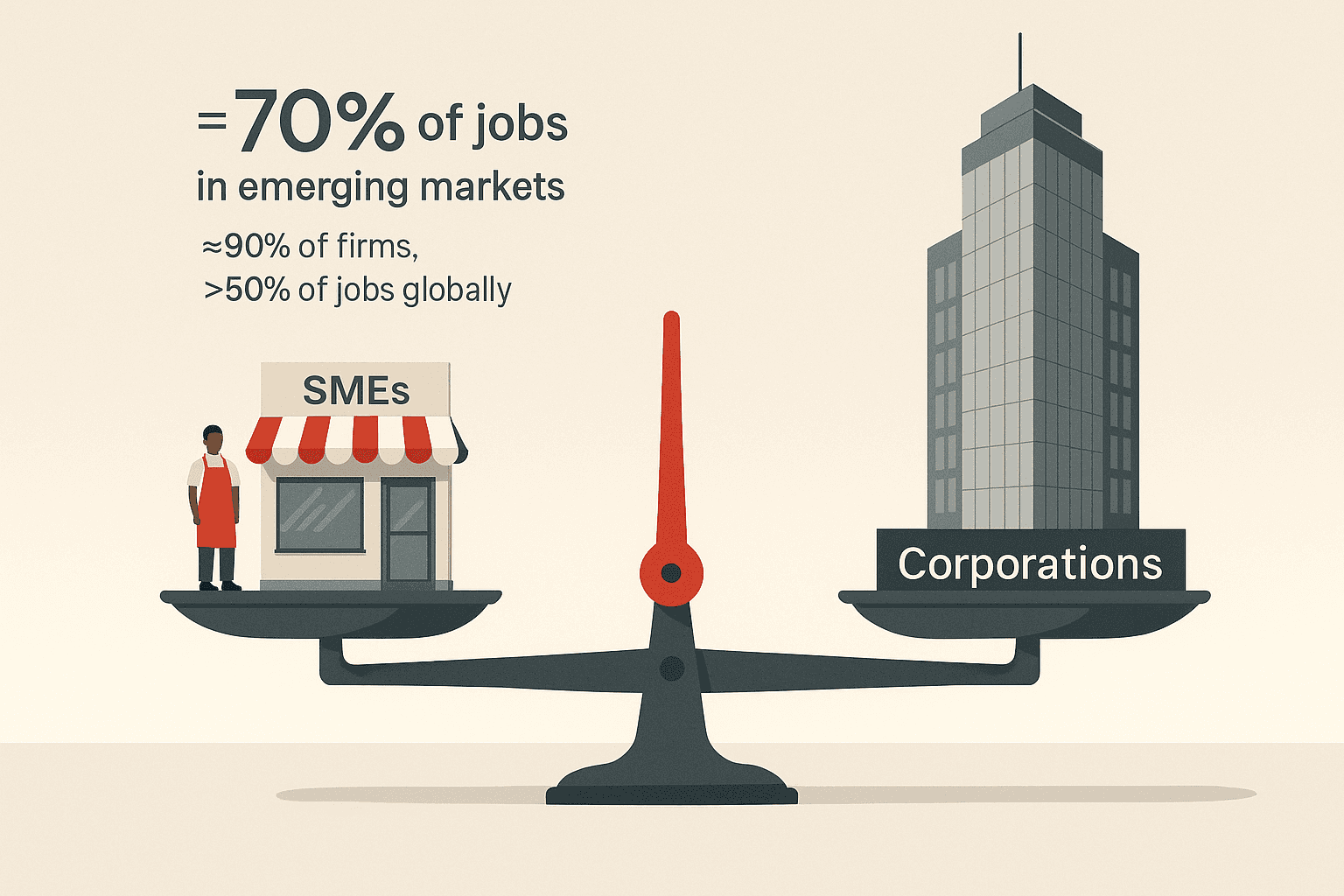
powering productivity: why small businesses drive the digital economy
how small businessesses narrow the productivity gap in the digital age
read more
growth
5 min read
ai and the new entrepreneurial wave: how small business reinvents growth
can technology allow small businesses to drive tomorrow's growth?
read more
automation opportunity self-assessment tool
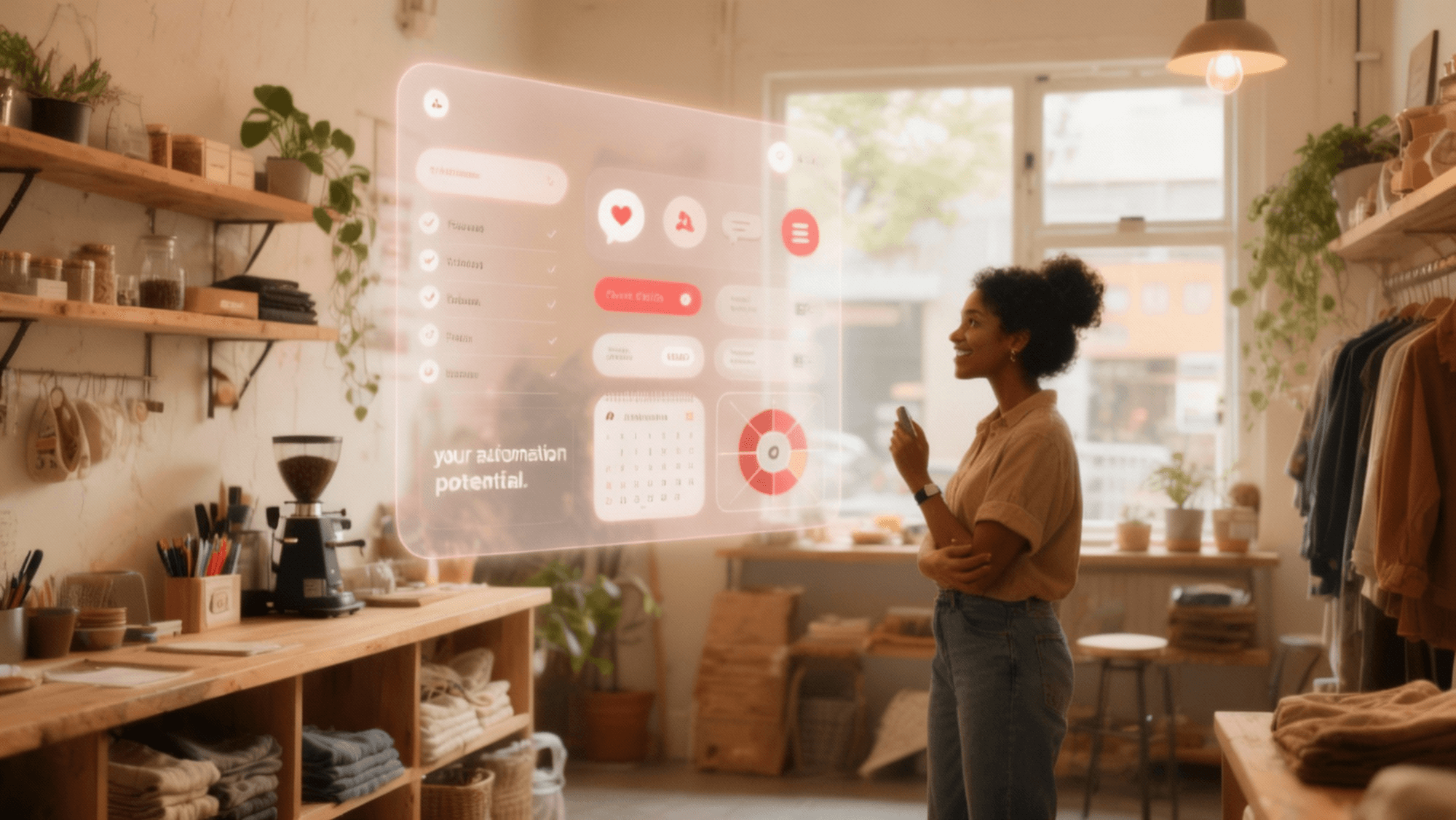
find out where automation can have the biggest impact in your business.
in a few quick questions, see how ready your systems are — and where ai can save you the most time and cost.
enterprise-level service without the enterprise price tag:
higher revenue and more efficient operations for 91% of smbs (source: salesforce via us chamber of commerce).
up to 80% of routine customer inquiries automatically (source: invesp)
improved response quality and speed in service for 90% of smbs (source: colorwhistle)
ar|in - automate your growth
meet ari, ar|in's ai workforce in action
discover how an ai-enabled automation workforce can transform your business. click a question on the right or ask your own to try ari live and get instant answers!
secure by design: "complies with the highest data protection standards, for private & secure interactions.
multitasker: "handles multiple customers at the same time—like a full team."
your agent, your brand: "applies your processes, in your brand voice, for your customers' needs."
natural conversations: "has normal, engaging conversations with your customers."
where your customers are: "serves customers where they prefer—web, social media, or messaging apps."
emotional intelligence: "understands & responds to customer emotions for better engagement."
always learning: "learns individual preferences from every interaction for a better experience next time."
ar|in - automate your growth
meet ari, ar|in's ai workforce in action
discover how an ai-enabled automation workforce can transform your business. click a question on the right or ask your own to try ari live and get instant answers!
secure by design: "complies with the highest data protection standards, for private & secure interactions.
multitasker: "handles multiple customers at the same time—like a full team."
your agent, your brand: "applies your processes, in your brand voice, for your customers' needs."
natural conversations: "has normal, engaging conversations with your customers."
where your customers are: "serves customers where they prefer—web, social media, or messaging apps."
emotional intelligence: "understands & responds to customer emotions for better engagement."
always learning: "learns individual preferences from every interaction for a better experience next time."
ar|in - automate your growth
meet ari, ar|in's ai workforce in action
discover how an ai-enabled automation workforce can transform your business. click a question on the right or ask your own to try ari live and get instant answers!
secure by design: "complies with the highest data protection standards, for private & secure interactions.
multitasker: "handles multiple customers at the same time—like a full team."
your agent, your brand: "applies your processes, in your brand voice, for your customers' needs."
natural conversations: "has normal, engaging conversations with your customers."
where your customers are: "serves customers where they prefer—web, social media, or messaging apps."
emotional intelligence: "understands & responds to customer emotions for better engagement."
always learning: "learns individual preferences from every interaction for a better experience next time."
ar|in - automate your growth
meet ari, ar|in's ai workforce in action
discover how an ai-enabled automation workforce can transform your business. click a question on the right or ask your own to try ari live and get instant answers!
secure by design: "complies with the highest data protection standards, for private & secure interactions.
multitasker: "handles multiple customers at the same time—like a full team."
your agent, your brand: "applies your processes, in your brand voice, for your customers' needs."
natural conversations: "has normal, engaging conversations with your customers."
where your customers are: "serves customers where they prefer—web, social media, or messaging apps."
emotional intelligence: "understands & responds to customer emotions for better engagement."
always learning: "learns individual preferences from every interaction for a better experience next time."
*expect a few seconds for a reply as your request gets sent to the correct automation workflow
not ready to book yet? check out our full features
ai agents industry insights & data
the data speaks for itself—ai is transforming customer service and business growth opportunities for companies of all sizes.
the small business opportunity
conversational ai empowers small businesses to offer enterprise-level service without the enterprise price tag:
enterprise-level service without the enterprise price tag:
can save up to 30% on customer service costs (source: forbes).
higher revenue and more efficient operations for 91% of smbs (source: salesforce via us chamber of commerce).
handle up to 80% of routine customer inquiries automatically (source: invesp)
up to 80% of routine customer inquiries automatically (source: invesp)
provide 24/7 customer support without additional staffing
improved response quality and speed in service for 90% of smbs (source: colorwhistle)
higher revenue and more efficient operations for 91% of smbs (source: salesforce via us chamber of commerce).
up to 80% of routine customer inquiries automatically (source: invesp)
improved response quality and speed in service for 90% of smbs (source: colorwhistle)
ar|in - automate your growth
ar|in - automate your growth
ar|in - automate your growth
ar|in - automate your growth
our tailored process to design, deploy, and optimize your ai agents
we make integrating ai simple and effective. from your first consultation through continuous support, we’re here to ensure your ai solution meets your specific needs and scales with your business.
step 1: consultation & needs assessment
together, we dive into your business’s goals and unique requirements, so we can tailor a solution that aligns with your objectives.
step 3: testing & quality assurance
we rigorously test your ai solution to ensure it meets high standards for seamless, reliable performance — adjusting based on your feedback.

step 2: custom chatbot design & development
we collaborate to design and build an ai agent that reflects your brand voice, processes, and customer experience needs.
step 4: management & upgrades
once launched, we stay by your side, continuously optimizing, managing, and enhancing your agent to keep it aligned with your evolving business.
step 1: consultation & needs assessment
together, we dive into your business’s goals and unique requirements, so we can tailor a solution that aligns with your objectives.
step 3: testing & quality assurance
we rigorously test your ai solution to ensure it meets high standards for seamless, reliable performance — adjusting based on your feedback
step 2: custom chatbot design & development
we collaborate to design and build an ai agent that reflects your brand voice, processes, and customer experience needs.
step 4: management & upgrades
once launched, we stay by your side, continuously optimizing, managing, and enhancing your agent to keep it aligned with your evolving business.
step 1: consultation & needs assessment
together, we dive into your business’s goals and unique requirements, so we can tailor a solution that aligns with your objectives.
step 3: testing & quality assurance
we rigorously test your ai solution to ensure it meets high standards for seamless, reliable performance — adjusting based on your feedback
step 2: custom chatbot design & development
we collaborate to design and build an ai agent that reflects your brand voice, processes, and customer experience needs.
step 4: management & upgrades
once launched, we stay by your side, continuously optimizing, managing, and enhancing your agent to keep it aligned with your evolving business.
step 1: consultation & needs assessment
together, we dive into your business’s goals and unique requirements, so we can tailor a solution that aligns with your objectives.
step 3: testing & quality assurance
we rigorously test your ai solution to ensure it meets high standards for seamless, reliable performance — adjusting based on your feedback.
step 2: custom chatbot design & development
we collaborate to design and build an ai agent that reflects your brand voice, processes, and customer experience needs.
step 4: management & upgrades
once launched, we stay by your side, continuously optimizing, managing, and enhancing your agent to keep it aligned with your evolving business.
not ready to book yet? click below and read how we keep your data safe
ar|in - automate your growth
ar|in - automate your growth
ar|in - automate your growth
ar|in - automate your growth
we want to be partners in your growth
i'm lamine kane, founder and builder of ar|in. with experience leading small businesses and multi-million-dollar corporate teams, i understand how challenging it is for small enterprises to compete with larger companies. that's why i created ar|in—to help bridge the gap with affordable ai solutions for customer engagement, sales, and the repetitive but important processes that keep businesses running.
we're here to help your small to medium-sized business fast and sustainably

learn more about ar|in
book your free consultation—let's get started!
ready to transform your business? let's explore how our ai agents can help you grow and scale.
pick a time that works for you, and we'll discuss your unique needs. our tailored ai solution will help you reach your goals—starting with a free consultation.
book your free consultation—let's get started!
ready to transform your business? let's explore how our ai agents can help you grow and scale.
pick a time that works for you, and we'll discuss your unique needs. our tailored ai solution will help you reach your goals—starting with a free consultation.
book your free consultation—let's get started!
ready to transform your business? let's explore how our ai agents can help you grow and scale.
pick a time that works for you, and we'll discuss your unique needs. our tailored ai solution will help you reach your goals—starting with a free consultation.
book your free consultation—let's get started!
ready to transform your business? let's explore how our ai agents can help you grow and scale.
pick a time that works for you, and we'll discuss your unique needs. our tailored ai solution will help you reach your goals—starting with a free consultation.
want to stay in the loop?
subscribe to our newsletter for regular insights on how to use ai to accelerate your business growth.
ar|in - automate your growth
ar|in - automate your growth
ar|in - automate your growth
ar|in - automate your growth
join our community for the latest updates and exclusive insights.
quick links
resources
© 2025 ar|in. all rights reserved.
© 2025 ar|in. all rights reserved.